
Call for a Consultation (239) 529-6053
Fort Myers Juvenile Defense Lawyer
Experienced Juvenile Defense Attorney in Fort Myers
A juvenile arrest can have long-reaching consequences that may not be apparent at the time. For a parent, it’s understandable to want to do whatever you can to protect your child and keep them out of a juvenile detention center. Juvenile allegations and charges can be very serious, and it’s important to take them as seriously as you would an adult charge. If your child is facing charges, you should contact a Fort Myers juvenile defense lawyer to help navigate the legal road ahead.
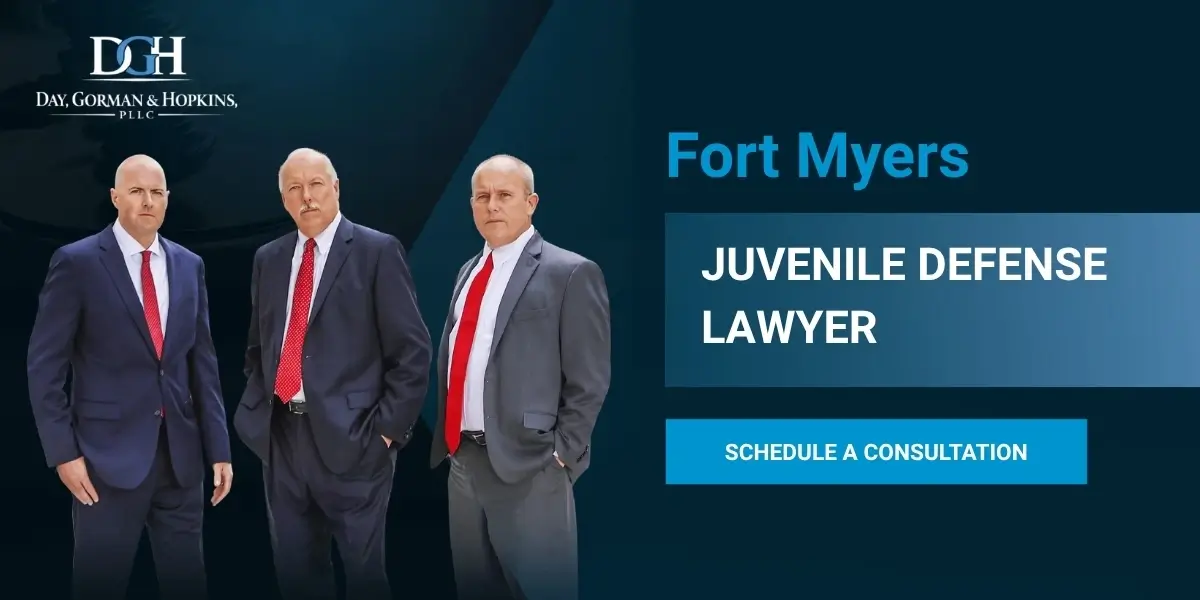
Hire a Juvenile Defense Lawyer
The team at Day, Gorman & Hopkins, PLLC can supply you with a sound strategy for your juvenile defense case. Florida’s juvenile defense laws can be difficult to navigate on your own, particularly when your emotions may be running high with the accusation against your child. A Fort Myers juvenile defense attorney from our team can help. Our decades of combined knowledge and experience will provide the needed confidence to push back against the charges.
The Long-Term Consequences of a Juvenile Conviction
Unfortunately, juvenile arrests are not rare in the state of Florida. During fiscal year 2024-2025, 26,138 youths were arrested for delinquent acts throughout the state. Many of those arrests were for drug crimes, which account for 28.7% of all criminal sentences in the state. In Fort Myers, these cases are handled by the Juvenile Division of the 20th Judicial Circuit Court at the Lee County Justice Center on Monroe Street.
There is a misconception that a juvenile criminal record won’t follow an individual in the same way that an adult criminal record would. Unfortunately, someone’s juvenile record can seriously affect their life as an adult, leading to long-term consequences not previously considered. It’s vital to think about everything that could be lost if your child is convicted. Here are some of the most common consequences of a juvenile record in Florida:
- Employment. Most employers will require a comprehensive background check if you are considered for the job. This is particularly true in the fields of law enforcement, education, healthcare, and law. In many cases, a juvenile record can disqualify you from further consideration, regardless of the details of your case.
- Education. If your child has plans to attend college and pursue higher education, a juvenile record could permanently derail those plans. A criminal conviction as a minor can result in denied college admissions, a loss of scholarships, and even restrictions on federal financial aid. If they are already enrolled, a criminal record could lead to academic suspension or even expulsion.
- Housing. To many potential landlords, a juvenile record is just as bad as an adult criminal record. The presence of a juvenile record can prevent your child from living in some public housing, including Section 8 housing. You and your family could even face eviction if your juvenile has a record, and the landlord no longer feels safe with you on their property.
- Future sentencing. If the juvenile in question later commits additional offenses as an adult, their prior record can be used to justify a harsher sentence, including a lengthier prison term. The violent crime rate in Florida is 267 per 100,000 people, which is lower than the national average, but still considerable, as is the property crime rate. Many of those offenders may have first been convicted as a juvenile.
- Driving privileges. Depending on the nature of the offense, such as an underage DUI, a juvenile conviction can ultimately lead to a loss of driving privileges. The juvenile could have their driver’s license suspended automatically or revoked entirely. This is quite common for convictions involving drugs and/or alcohol.
FAQs
What Are the Three Rights of a Juvenile?
Juveniles who are facing delinquency charges have the same rights as any adult who is facing criminal charges. Remember, juveniles are American citizens too, and they are afforded their constitutional rights. The three rights that are primarily exercised during an arrest are the right to legal counsel, the right to remain silent, and the right to confront witnesses. Juveniles can call a lawyer, refuse to speak to police, and be informed of the case against them.
What Is the Youngest Age Someone Can Be Prosecuted in Florida?
The minimum age for juvenile prosecution in Florida is seven years old. Any child younger than seven cannot be arrested or charged for a delinquent act unless the violation is a forcible felony. Forcible felonies include murder, manslaughter, aggravated assault, arson, burglary, kidnapping, and treason, all of which are uncommon in children under seven years old. If your child commits a crime, you should hire a juvenile defense lawyer to plan your next move.
What Are the Seven Steps in the Juvenile Justice Process?
In Florida, the seven steps in the juvenile justice process are as follows: The initial arrest, the detention hearing, intake and diversion, a delinquency petition, the arraignment, the adjudicatory hearing, and the disposition. It’s recommended that you contact a juvenile defense lawyer to help you through every one of these steps. The juvenile justice system prioritizes rehabilitation over punishment to prevent juveniles from becoming adult offenders.
Can You Charge a 12-Year-Old As an Adult?
A 12-year-old can be charged as an adult in Florida, though it is rare, highly restricted, and depends entirely on the severity of the offense. This generally only happens in cases involving capital offenses. If a 12-year-old is facing charges for a capital offense, the state attorney can seek a grand jury indictment to determine if that child should be tried as an adult.
Fort Myers Juvenile Defense Lawyer
If your child has been charged with a crime, it is important to seek legal counsel. With their future on the line, a mistake in their youth should not mean a lifetime of hardship. At Day, Gorman & Hopkins, PLLC, we can assist you in building a defense, analyzing evidence, and bolstering your confidence to help you and your child successfully navigate the criminal justice process. Contact us to speak with a member of our team.

Call for a Consultation (239) 529-6053
3550 Tamiami Trail E.
Naples, FL 34112
Fax: 239-529-6293
© Copyright 2026 Day, Gorman & Hopkins, PLLC. All rights reserved. Disclaimer | Site Map | Privacy Policy
*Images are obtained under license from Canva and other third-party stock image providers, with attribution included where required.
Digital Marketing By 